Advanced Pricing Module Rules

The Advanced Pricing Module (APM) provides a flexible rule engine that enforces pricing logic and compliance across Back Office and Mobile. APM rules can automatically add required or recommended items, prohibit incompatible items, override prices or costs, and inject location-based fees or taxes based on defined conditions.

APM Rule Types

These rules go beyond the Back Office-only approach in FX CPQ (legacy) by introducing compliance actions and dynamic triggers.

Advanced Pricing Module (APM) rule types are defined by FieldFX and are not user‑extensible.

Administrators cannot create or add new rule types but can add rules within the supported APM rule types to model pricing, compliance, and enforcement behavior.

Each rule type has steps in a separate topic.

Rule Type Description Use Cases

Automatically add mandatory items to quotes or tickets when conditions are true

  • Example: Add PPE kits or consumables linked to a service package Enforces compliance by preventing ticket completion without required items

Automatically add mandatory PPE items when the user selects the safety checkbox on a ticket

  • Append compliance-related items (e.g., manifests, testing kits) when hazardous waste disposal is involved

  • Bundle consumables (O-rings, gaskets, chemicals) with service kits to ensure completeness and margin protection

  • Suggest additional items that are not mandatory but commonly paired with selected services.

    • Example: Recommend corrosion inhibitor at a high-pressure pump service

  • Suggest optional accessories or add-ons when quoting premium services.

  • Propose environmental spill kits for jobs flagged in sensitive zones.

  • Recommend efficiency-enhancing tools upon selection of certain equipment

  • Block the addition of items that should not be used under certain conditions.

  • Example: Prevent incompatible chemicals from being added to a job with sour gas presence.

  • Block incompatible items when a corrosive environment flag is active.

  • Prevent selection of non-compliant materials for sour gas operations.

  • Disallow outdated or restricted SKUs based on regulatory condition

  • Override standard pricing or cost values based on predefined triggers.

  • Example: Apply a surcharge for remote locations or adjust disposal fees based on waste type and facility capability.

  • Adjust rates dynamically based on operating conditions (e.g., down-hole temperature/pressure bands).

  • Apply location-specific surcharges for remote sites or offshore jobs.

  • Modify disposal fees based on waste type and hauling distance zone.

  • Inject correct regional taxes, carbon fees, and municipal levies automatically.

Dynamically adjust pricing or enforce actions based on operational conditions: * Downhole temperature/pressure bands * Corrosive environment flags * Sour gas presence * Hauling distance zones

  • Trigger child items when a parent item is added under certain conditions (e.g., adding a pump auto-adds hoses and fittings).

  • Apply mobilization/demobilization charges when convoy or road permits are required

  • Add location-specific surcharges or mobilization/demobilization fees when job site meets configured conditions (e.g., offshore, Hâ‚‚S zone).

  • Apply remote site surcharges for jobs in hard-to-reach areas (e.g., offshore rigs, mountainous regions).

  • Add mobilization/demobilization charges when convoy or special transport permits are required.

  • Include road permit fees automatically for oversized equipment moves.

  • Trigger H2S zone hazard premiums when the job site falls within a configured safety zone.

  • Adjust pricing for urban vs. rural locations to reflect logistical complexity.

  • Inject correct tax codes, carbon fees, spill response charges, and municipal levies based on geography and service category.

  • Inject correct regional tax codes based on job geography and service category.

  • Apply carbon fees for operations flagged under emissions compliance programs.

  • Add spill response fees for jobs involving hazardous materials or sensitive ecosystems.

  • Include municipal levies for waste disposal or water usage tied to local regulations.

  • Automate environmental surcharges for drilling mud disposal or brine hauling to reduce A/R disputes.

CPQ Rules

CPQ rules are logic-based conditions helping to control how products, services, and pricing behave when users build quotes, jobs or tickets. They guide users so quotes stay consistent, accurate and compliant with your org’s business processes.

They apply in these areas:

  • Quote Building - making sure the right products or services are selected

  • Job Creation - controlling resource or item selections

  • Pricing - adjusts or restricts how prices appear

  • Approvals - ensures certain conditions trigger approvals before a quote can be finalized

CPQ Rule Categories

You can add, edit, or clone CPQ Rules.

FieldFX CPQ rules work identically to other rules with these exceptions:

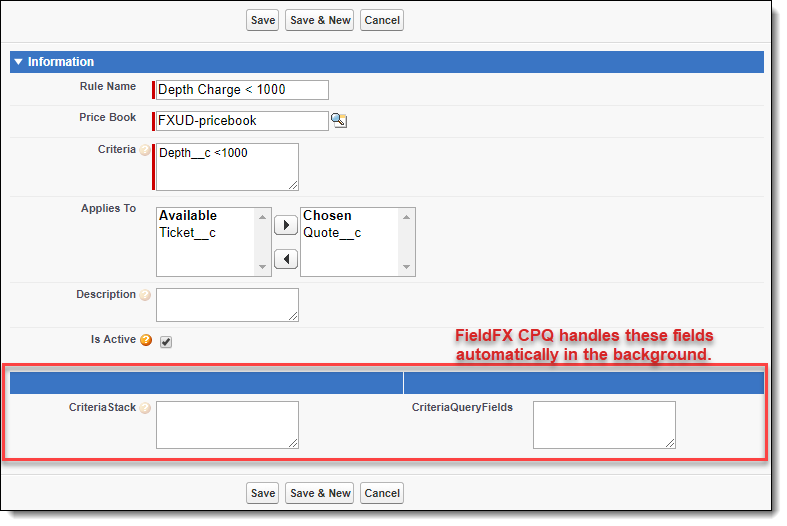
  • The CriteriaQueryFields and Criteria Stack fields do not generate when cloning or updating an existing rule.

  • The FX5__CriteriaStack__c field must be added to the Rules page layout (See Page Layouts)

  • CPQ handles these fields automatically in the background.

Do not add or change the CriteriaQueryFields and Criteria Stack fields when working with CPQ rules.

Highlighting the CriteriaStack and CriteriaQueryFields

Add CPQ Rules

  1. Add a Quote Rule or Add a Ticket Rule.

    Do not complete the CriteriaQueryFields and Criteria Stack fields.

    FX CPQ (legacy) handles these fields automatically in the background.

  2. Click Save.

Edit CPQ Rules

  1. Access FieldFX Back Office.

  2. Switch to Salesforce Classic.

  3. Select the Rules tab.

  4. Select the rule and select Edit.

  5. Update the Criteria field.

    Do not update the CriteriaQueryFields and CriteriaStack fields.

    CPQ handles these fields automatically in the background.

  6. Select Save.

Clone CPQ Rules

  1. Access FieldFX Back Office.

  2. Switch to Salesforce Classic.

  3. Select the Rules tab.

  4. Select the rule and select Clone.

  5. Update the Rule Name and Price Book fields.

  6. Update the criteria.

    Do not complete the CriteriaQueryFields and Criteria Stack fields.

    FX CPQ (legacy) handles these fields automatically in the background.

  7. Select Save.