Invoice Items
Introduction
An invoice item is a price book item or ticket item on an invoice.
Use the Invoice Item Builder to add invoice items.
Invoice Item Relationships
-
Price Book Items - You can add items from any price book to an invoice.
For more information, see Copy Data from Price Book Items. -
Ticket Items - You can add items from any ticket on the customer’s jobs to an invoice.
For more information, see Copy Data from Ticket Items.
Prerequisites
To set up and use Invoice Items, you need to:
| Have these user licenses | Have these permissions | Complete these tasks and review these topics before continuing |
|---|---|---|
Behavior
This section explains how invoice items behave when edited individually or in bulk, including sequencing, locking, and inheritance rules.
Bulk Edit allows you to update multiple invoice items at the same time using a single action. To preserve data integrity and pricing accuracy, invoice items behave differently during Bulk Edit than when editing a single record.
Supported Updates
Bulk Edit is intended for safe, high‑volume updates across multiple invoice items. Depending on your configuration, you can use Bulk Edit to update:
-
Common non‑calculated fields
-
Status or workflow‑related fields
-
Administrative fields that do not affect pricing, totals, or derived values
The same value is applied to all selected invoice items.
Fields Not Editable During Bulk Edit
Some invoice item fields are intentionally restricted during Bulk Edit.
The following types of fields cannot be updated using Bulk Edit:
-
Time‑based fields
-
Calculated or system‑managed fields
-
Fields whose values are derived from pricing rules, totals, or rollups
These fields may be editable when working with a single invoice item, but are read‑only or unavailable during Bulk Edit.
Bulk Edit vs. Single Invoice Item Edit
Bulk Edit and single‑record editing follow different validation rules.
-
Bulk Edit applies one value across multiple records
-
Validation rules may be more restrictive during Bulk Edit
-
Fields editable on an individual invoice item may be locked during Bulk Edit
If you need to update restricted fields, edit the invoice items individually instead of using Bulk Edit.
Validation and Save Behavior
When using Bulk Edit:
-
Fields that cannot be updated are disabled or unavailable for selection
-
If a selected update is not permitted, the save action is blocked
-
Partial updates are not applied—either all selected invoice items are updated successfully, or no changes are saved
This ensures consistency across all selected records.
Recommended Usage
| Use Bulk Edit when you need to: | Use single‑record editing when you need to: |
|---|---|
|
|
| Invoice item Bulk Edit behavior was clarified starting with FXLC v1.297. |
Deprecated VisualForce Pages
Click to expand
Starting in FX26R1, several legacy Salesforce Visualforce pages used by some back-office users are no longer supported. These pages were deprecated to address security review requirements.
The deprecated pages include:
-
CreditMemo.page -
InvoiceItems.page -
QuoteItems.page -
TicketItems.page -
JobDirections.page -
JobShiftScheduling.page -
JobWhiteboard.page -
PacketViewer.page
If your previous workflows relied on opening these pages directly (for example, from a custom button, tab, or bookmark), you will now use the current UI instead.
Use the following paths to complete your day-to-day tasks:
| Deprecated VF page | New equivalent (if any) | Notes |
|---|---|---|
|
Salesforce Files + updated FieldFX file sync |
Attachment Ext & Chatter integration retired. |
|
No new FieldFX replacement; ERP expected to handle |
Credit Memo objects themselves are retired (see 2023 Feature Retirement). |
|
Lightning related lists + modern FFX grids/CPQ |
Same data; VF grids removed for security; use Lightning pages and newer pricing/CPQ UIs. |
|
Lightning components / custom links to maps |
No direct VF replacement; rely on address fields + external map links. |
|
Service Board / modern scheduling UIs |
Old scheduling VF replaced conceptually by Service Board & new Shift Scheduling app. |
|
Files + document templates on Jobs/Tickets |
Packets represented as generated files/reports. |
|
|
|
| If a button or tab that you used previously now shows an error or no longer opens the expected page, contact your Salesforce administrator. They may need to update your org’s customizations to point to the current FieldFX pages. |
Step-by-Step Guides
For behavioral rules and limitations, see Invoice Item Behavior.
You can:
Adding Ticket Items to an Invoice
|
The Invoice Item Builder and the “Add Ticket Items to Invoice” workflow are deprecated and no longer supported. FieldFX now uses a Lightning‑based, ticket‑driven invoicing model. Billable items are added to tickets as ticket items, which are linked to price book items. Invoices are then created from those tickets, using the ticket items as the source of invoice line items. |
|
FieldFX has deprecated these items, for the same functionality, use the listed alternative.
|
Adding Ticket Items using the Invoice Item Builder - click to expand
-
Open the Invoice Item Builder.
-
Click Expand on the right side of the page.

-
Click Available Items on the Item picker.
-
Open the Available Tickets tab.
-
Select filters to locate the ticket items.
-
Click Search.
-
Select the ticket items to invoice.
Idisplays next to ticket items already on the invoice. -
Click Add Selected.
Child items get added automatically when you add their parent item. -
Click Close on the left side of the Available Items picker.

Adding Price Book Items to an Invoice
The Price Book Item Builder and the “Add Price Book Items to Invoice” workflow are deprecated and no longer supported.
FieldFX now uses a Lightning‑based, ticket‑driven invoicing model. Billable items are added to tickets as ticket items, which are linked to price book items. Invoices are then created from those tickets, using the ticket items as the source of invoice line items.
|
FieldFX has deprecated these items, for the same functionality, use the listed alternative.
|
Using Invoice Item Builder - click to expand
-
Open the Invoice Item Builder.
-
Click Expand on the right side of the page.
-
Click Available Items on the Item picker.
-
Open the Available Tickets tab.
-
Select filters to locate the price book items.
-
Click Search.
-
Select the price book items to add.
-
Click Add Selected
Child items get added automatically when you add their parent item. -
Click Close on the left side of the Available Items picker.
Adding Child Invoice Items
Prerequisite: Designate dynamic parent items.
|
The Price Book Item Builder and the “Add Price Book Items to Invoice” workflow are deprecated and no longer supported. FieldFX now uses a Lightning‑based, ticket‑driven invoicing model. Billable items are added to tickets as ticket items, which are linked to price book items. Invoices are then created from those tickets, using the ticket items as the source of invoice line items. |
|
FieldFX has deprecated these items, for the same functionality, use the listed alternative.
|
Adding child items using the Invoice Item Builder - click to expand
-
Open the Invoice Item Builder.
-
Move down to the Item grid.
-
Select Add Child Items next to a dynamic parent item.

-
Select child items.
-
Click Add Selected.
The child items display indented under their parent item.
-
Click Close on the left side of the Available Items picker.
-
Click Add Child Items.

Add Child Items mode is now disabled.
Copying Data from Price Book Items
-
When you add a price book item to an invoice, data copies from the price book item to the invoice item.
-
Data copies between the following managed fields by default:
Click to view default field mappings
Price Book Item Field Invoice Item Field FX5__Catalog_Description__c
FX5__Description_Override__cFX5__Description__cFX5__Catalog_Item_Code__cFX5__Item_Code__cFX5__Catalog_UOM__cFX5__Catalog_UOM__cFX5__COGS_Account__cFX5__COGS_Account__cFX5__Default_Qty__cFX5__Qty__cFX5__Discount_Percent__cFX5__Discount_Percent__cFX5__Income_Account__cFX5__Income_Account__cFX5__Price__cFX5__Price__cFX5__Sequence_Number__cFX5__Sequence_Number__c -
You can add custom fields to copy additional information between price book items and invoice items.
Make sure custom fields have the same name, data type, length, and decimal places on both the Price Book Item and Invoice Item objects.
Copying Data from Ticket Items
-
When you add a ticket item to an invoice, data copies from the price book item or ticket item to the invoice item.
-
Data copies between the following managed fields by default:
Click to view default field mappings
Ticket Item Field Invoice Item Field Extended_Amount__cFX5__Extended_Amount__cFX5__Catalog_UOM__cFX5__Catalog_UOM__cFX5__COGS_Account__cFX5__COGS_Account__cFX5__Description__cFX5__Description__cFX5__Discount_Percent__cFX5__Discount_Percent__cFX5__Income_Account__cFX5__Income_Account__cFX5__Item_Code__cFX5__Item_Code__cFX5__Price__cFX5__Price__cFX5__Price_Book_Item__cFX5__Price_Book_Item__cFX5__Sequence_Number__cFX5__Sequence_Number__c -
You can add custom fields to copy additional information between ticket items and invoice items.
Make sure custom fields have the same name, data type, length, and decimal places on both the Ticket Item and Invoice Item objects.
Editing an Invoice Item
|
The steps in this section describe the classic Invoice Item Builder experience. In the Lightning Experience, use the Bulk Edit – Invoice Item tool. In Lightning, existing Invoice Items remain editable in bulk even when the invoice’s parent Price Book is expired. However, controls that add or copy items from the expired Price Book are disabled or read-only. |
-
Open the Invoice Item Builder.
-
Move down to the Item grid.
-
Click the arrow next to the item.

-
Click Edit.
-
Make edits.
-
You can’t edit the discount for items that have Locked Discount selected.
-
You can’t edit the price for items that have Locked Price/Markup selected.
-
-
Click Save.
Deleting Invoice Items
-
Open the Invoice Item Builder.
-
Move down to the Item grid.
-
Select items.
Child items get deleted automatically when you delete their parent item.
-
Click Delete Selected.
-
Click OK.
Editing Multiple Invoice Items
-
Open the Invoice Item Builder.
-
Move down to the Item grid.
-
Select items.
-
Click Bulk Update.
-
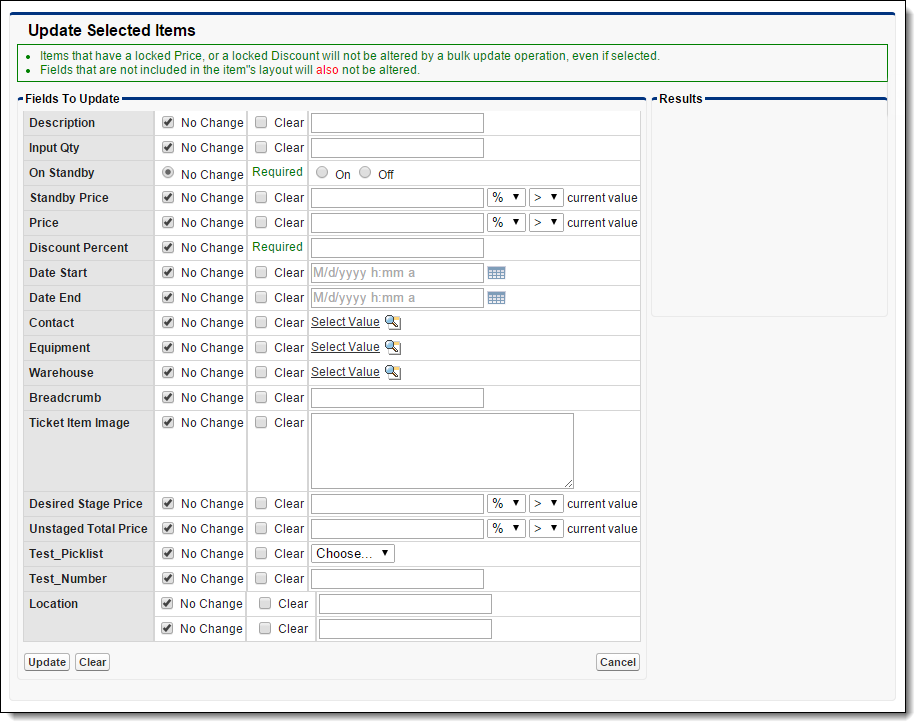
Make edits on the Updated Selected Items panel.
-
You can’t edit the discount for items that have Locked Discount selected.
-
You can’t edit the price for items that have Locked Price/Markup selected.
-
-
Click Update.
Recommended Reading
-
FX Invoicing Minimum Permissions - Learn the minimum permissions required to use invoice items.
-
Invoice Workflow Setup - Learn about invoice workflow components.