Price Book Items
Introduction
A Price Book Item is a billable item in a Price Book, such as labor or a service.
|
FieldFX’s Price Book Builder functionality has been deprecated.
|
Use the Price Book Builder to add Price Book Items.
When you add a Price Book Item, you can add the item to:
Prerequisites
To set up and use Price Book Items, you need to:
| Have these user licenses | Have these permissions | Complete these tasks and review these topics before continuing |
|---|---|---|
Deprecated Visualforce Page
Click to expand
Starting in FX26R1, several legacy Salesforce Visualforce pages used by some back-office users are no longer supported. These pages were deprecated to address security review requirements.
The deprecated pages include:
-
CreditMemo.page -
InvoiceItems.page -
QuoteItems.page -
TicketItems.page -
JobDirections.page -
JobShiftScheduling.page -
JobWhiteboard.page -
PacketViewer.page
If your previous workflows relied on opening these pages directly (for example, from a custom button, tab, or bookmark), you will now use the current UI instead.
Use the following paths to complete your day-to-day tasks:
| Deprecated VF page | New equivalent (if any) | Notes |
|---|---|---|
|
Salesforce Files + updated FieldFX file sync |
Attachment Ext & Chatter integration retired. |
|
No new FieldFX replacement; ERP expected to handle |
Credit Memo objects themselves are retired (see 2023 Feature Retirement). |
|
Lightning related lists + modern FFX grids/CPQ |
Same data; VF grids removed for security; use Lightning pages and newer pricing/CPQ UIs. |
|
Lightning components / custom links to maps |
No direct VF replacement; rely on address fields + external map links. |
|
Service Board / modern scheduling UIs |
Old scheduling VF replaced conceptually by Service Board & new Shift Scheduling app. |
|
Files + document templates on Jobs/Tickets |
Packets represented as generated files/reports. |
|
|
|
| If a button or tab that you used previously now shows an error or no longer opens the expected page, contact your Salesforce administrator. They may need to update your org’s customizations to point to the current FieldFX pages. |
Record Types
When you add a Price Book Item record type, you must also add the record type to:
-
The Catalog Item object.
-
The Ticket Item Record Type picklist on the Catalog Item object.
-
The Quote Item object.
-
The Ticket Item object.
Relationship with Catalog Items
A Price book item must be linked to a Catalog Item.
Typically, you add one Price Book Item for a Catalog Item per Price Book. You can also add multiple Price Book Items for a Catalog Item if they are Child Items in the same package.
Copy Data to Price Book Items
When you add a Price Book Item, FieldFX copies data from the linked Catalog Item to the Price Book Item.
FieldFX copies data between the following managed fields by default:
| Catalog Item Field | Price Book Item Field | ||
|---|---|---|---|
|
|
||
|
|
||
|
|
||
|
|
||
|
|
||
|
|
||
|
|
||
|
|
You can add custom fields to copy additional information between Catalog Items and Price Book Items.
|
Make sure custom fields have the same name, data type, length, and decimal places on both the Catalog Item and Price Book Item objects. |
Relationship with Quote Items
You can add Price Book Items to a quote from the:
-
Price book for the quote
-
Price books you have permission to access
-
Price books above the quote’s Price Book in a hierarchy
Copy Data to Quote Items
When you add a Price Book Item to a quote, FieldFX copies data from the Price Book Item to the Quote Item.
FieldFX copies data between the following managed fields by default:
| Price Book Item Field | Quote Item Field |
|---|---|
|
N/A To copy data from the FX5__Catalog_Cost__c field to Quote Items, add a custom field named Cost__c to the Quote Item object. |
If you don’t make an entry in the FX5__Description_Override__c field, Quote Items inherit their description from the FX5__Catalog_Description__c field in the Price Book Item. |
|
|
|
|
|
|
|
|
|
|
|
|
|
|
|
|
|
|
|
|
|
|
|
|
|
|
|
|
|
|
|
|
|
|
|
|
|
|
|
|
|
You can add custom fields to copy additional information between Price Book Items and Quote Items.
|
Make sure custom fields have the same name, data type, length, and decimal places on both the Price Book Item and Quote Item objects. |
-
Fields prefixed with
Locked_are boolean fields that, whenTrue, prevent the related field from being edited. -
You can add your own custom locking fields to Price Books.
Relationship with Ticket Items
You can add Price Book Items to a ticket from the:
-
Price book for the job
-
Price books you have permission to access
-
Price books above the job’s Price Book in a hierarchy
Copy Data to Ticket Items
When you add a Price Book Item to a ticket, data copies from the Price Book Item to the Ticket Item.
FieldFX copies data between the following managed fields by default:
| Price Book Item Field | Ticket Item Field |
|---|---|
|
|
If you don’t make an entry in the FX5__Description_Override__c field, |
|
|
|
|
|
|
|
|
|
|
|
|
|
|
|
|
|
|
|
|
|
|
|
|
|
|
|
|
|
|
|
|
|
|
|
|
|
|
|
|
|
|
|
|
|
|
|
|
|
|
|
You can add custom fields to copy additional information between Price Book Items and Ticket Items.
|
Make sure custom fields have the same name, data type, length, and decimal places on both the Price Book Item and Ticket Item objects. |
Parent and Child Items
A Parent Item has a master-detail relationship with one or more Child Items.
A Child Item can only have one parent and cannot be the parent of another item.
Add a kit for the 20K Hydroblasting service that includes equipment, labor, service, and supply Price Book Items.
Create Parent-Child Relationships
There are two ways to create parent-child relationships between items:
| Static Parenting | Dynamic Parenting |
|---|---|
Define parent-child relationships at the Price Book level using Requires Parent Item and Parent Price Book Item. |
Create parent-child relationships on the fly when users add items to quotes, tickets, invoices, or job resources. |
Child items are added automatically when the parent is added. |
Users select select and add Child Items to the parent at the time of creation. |
Configured on the child item. |
Configured on the parent item (select Enable Dynamic Parenting). |
For details and set up steps, see Designate a Dynamic Parent Item.
For job resource bundle behavior (status inheritance, delivery ticket rules, and quantity restrictions), see Job Resources and Job Resource Use.
Static Parenting
Use Static Parenting to create parent-child relationships at the Price Book level.
To set up this feature, complete the following for desired Child Items:
-
Select Requires Parent Item
-
Select a Parent Price Book Item
Dynamic Parenting
Use Dynamic Parenting to let users create parent-child relationships at the time they add items — rather than defining them in advance at the Price Book level.
When you add a Dynamic Parent item from a Price Book or Quote with a quantity greater than one, FieldFX creates a separate Job Resource bundle for each unit. Each bundle contains its own Parent Item and associated Child Items.
When you select Enable Dynamic Parenting (FX5__Enable_Dynamic_Parenting__c) on a Price Book Item, users can add Child Items to this parent when creating quotes, tickets, invoices, or job resources.
For job resources, enabling Dynamic Parenting means that when the item is added to a Job Resource grid, it becomes a bundle parent (Job Resource context only). All Child Items defined in the Price Book are automatically added as child job resources. For details, see Job Resource Bundles for details on bundle behavior, status inheritance, and delivery ticket rules.
|
Do not select Enable Dynamic Parenting if the item is the child of another item. |
To set a dynamic Parent Items, select Enable Dynamic Parenting
|
The quantity of a parent Job Resource in a bundle is always 1 and cannot be changed. When generating a Delivery Ticket from a Job Resource bundle, the bundle must be added as a whole — you cannot split a parent-child bundle across multiple delivery tickets. Labor and Service Child Items are excluded from delivery Ticket Items. |
For details, see Job Resource Bundles for details on bundle behavior, status inheritance, and delivery ticket rules
|
The Child Items cannot be parents of other items. |
After a bundle is added to a Job, users can add or remove Child Items from that bundle as needed.
How to Use Parent and Child Items
Parent and Child Items display grouped together, with Child Items indented under the parent. Example 2. A Ticket Item list in FieldFX Mobile with parent and Child Items
The Ticket Item grid groups parent and Child Items together. 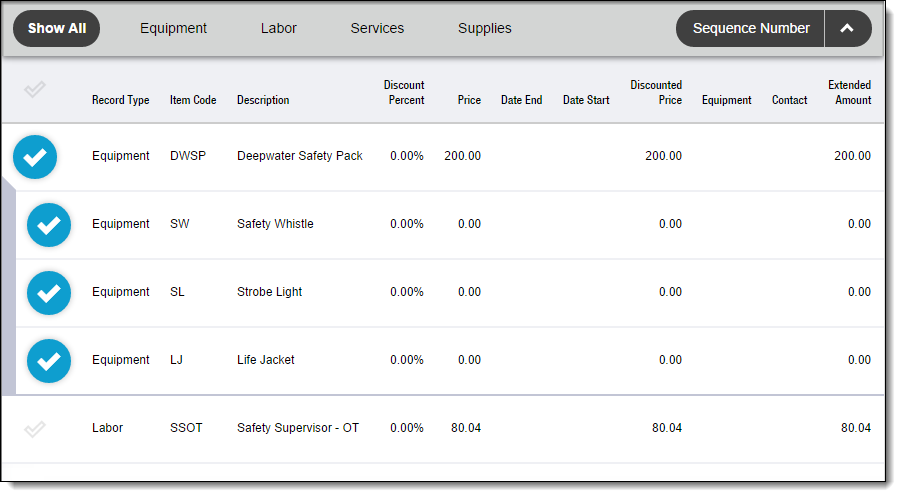
Figure 1. In FieldFX Mobile, Child Items of a parent in a Ticket Item list are grouped together and indented under the Parent Item.
|
|
When you delete a Parent Item, any Child Items also get deleted. When you delete a Child Item, only that item gets deleted. |
Price Book Constraints
A Price Book constraint is control on a Price Book Item that enforces restrictions when you add the item to quotes/tickets.
You can define a Minimum Charge for an item so that users can’t change the sales price to below the specified minimum.
Price book constraints maintain contract compliance by preventing changes to item quantities and pricing.
How It Works
Make an entry or selection in one of the following fields to enforce a Price Book constraint:
| Field | Constraint |
|---|---|
Default Quantity |
Specify a Default Quantity so the item gets added in that quantity. |
Included Quantity |
Specify an Included Quantity so customers receive that quantity at no charge but must pay for extra items. |
Minimum Quantity |
Specify a Minimum Quantity so you can’t add less than that quantity of the item. |
Maximum Quantity |
Specify a Maximum Quantity so you can’t add more than that quantity of the item. |
Locked Description |
Select Locked Description so you can’t change the item’s description. |
Locked Discount |
Select Locked Discount so you can’t change the item’s discount. |
Locked Price/Markup |
Select Locked Price/Markup so you can’t change the item’s price. |
Minimum Charge |
Specify a Minimum Charge so you can’t charge less than that amount for the item. |
Step-by-Step Guides
Add Multiple Items using the Price Book Builder
|
FieldFX’s Price Book Builder functionality has been deprecated.
|
-
Click Expand on the right side of the page

-
Select Catalog Items
-
Click Add Selected
Child items get added automatically when you add their Parent Item.
-
Click Close on the left side of the Item picker

Add a Single Item
-
Open the Price Books tab.
-
Open the Price Book.
-
Under Price Book Items, click New.
-
Complete the following:
Field Action Sequence Number
Enter a sequence number to use for the item.
Sequence numbers control the order of Price Book Items in lists. For details, see that topic.
Catalog Item
Select the Catalog Item for which you are adding the Price Book Item.
Use a standard price
Select "Straight Price" in Pricing Method and enter a Price to set a price for the item.
Mark up the item by a dollar amount
Select "Cost Plus Markup Amount" in Pricing Method and enter a Cost Plus Markup Amount to set a price for the item.
You must also enter a Cost for the linked Catalog Item.
Mark up the item by a percentage of cost
Select "Cost Plus Markup Percent" in Pricing Method and enter a Cost Plus Markup Percent to set a price for the item.
You must also enter a Cost for the linked Catalog Item.
Discount Percent
Enter the percentage discount to grant on the Price Book Item.
Default Quantity
Included Quantity
Enter the quantity to give customers at no charge.
Example 4. Included Qty is 3 and 5 items are addedIf the Included Qty is three and you add five items to a ticket, the customer receives three items at no charge and must pay for two items.
Description Override
Enter a catalog description to use for the item in this Price Book.
This entry overrides the description inherited from the linked Catalog Item.
For details, see the Parent & Child Items section above for more information on this feature.
Do not select this option if the item is the child of another item.
Requires Parent Item
Select to make this item a child of another Price Book Item. Then, select a Parent Item in Parent Price Book Item.
- Enable Dynamic Parenting
-
Select to allow users to add Child Items to this item when creating quotes, tickets, invoices, or job resources. When selected, this item can serve as a dynamic parent — users create parent-child relationships on the fly rather than defining them at the Price Book level.
On the Job Resources grid, an item with Enable Dynamic Parenting selected becomes a bundle parent. See Dynamic Parenting for details.
Do not select this option if the item is the parent of another item.
An item cannot be both a child of an item and the parent of another item.
When you select Requires Parent Item, you can’t add the item to quotes/tickets without adding its Parent Item first.
For details, see the Parent & Child Items section for Parent & Child Items relationships.
Surcharge Fuel
Select to apply a surcharge for fuel costs.
Required Item
Don’t select Required Item for Child Items.
If you deselect Required Item, any existing Quote Items/Ticket Items will still be required.
Standby Price
Enter the price to charge when the item is on standby and not in use on a job
Example 5. Moving a Crane to a work siteIf you move a crane to a work site and the customer delays the start of the job, charge the customer the standby price for the crane until the job begins.
Minimum Charge
Enter the minimum price to charge for the item.
Locked Description
Select to prevent users from changing the item’s description.
Locked Discount
Select to prevent users from changing the item’s discount percentage.
You can’t apply stage pricing to Price Book Items that have Locked Discount selected.
Locked Price/Markup
Select to prevent users from changing the item’s price or markup.
Minimum Quantity
Maximum Quantity
Currency
Select the currency in which to display the item’s prices.
This field displays if you enable the Multiple Currency feature.
The currency you select overrides the default currency for the Price Book.
-
Click Save.
Recommended Reading
-
Price Book Item Setup - Learn how to set up Price Book Items.